For decades, the financial markets were dominated by a handful of institutions with access to proprietary data feeds, co-located servers, and armies of PhD quants. The average trader — even a sophisticated one — had no realistic shot at competing on a level playing field. That gap is finally narrowing, not because the institutions have slowed down, but because artificial intelligence has made institutional-grade intelligence accessible at scale.
At StockHunt, we've spent the last three years building CoinIQ, our proprietary AI signal engine. What started as an internal research project has grown into one of the most accurate real-time signal generators in the crypto derivatives space — and along the way, we learned a tremendous amount about what AI can and cannot do in live markets.
What Does 'AI Trading' Actually Mean?
The phrase 'AI trading' gets thrown around so loosely that it has become almost meaningless. A spreadsheet with a moving average is not AI. A chatbot that tells you to buy Bitcoin is not AI. Real AI trading involves models that learn from historical and real-time data, identify non-obvious patterns in price action, order flow, funding rates, and on-chain behavior, and generate probabilistic signals that have statistically significant predictive power.
There are broadly three families of AI models used in live trading environments today. Each has a distinct role, and the most sophisticated firms — including ours — use all three in concert.
1. Supervised Learning for Signal Generation
Supervised learning models are trained on labeled historical data. In a trading context, this means feeding the model thousands of market scenarios — funding rate spikes, liquidation cascades, volume imbalances — alongside the price outcome that followed. The model learns to associate specific market conditions with likely price direction.
Our CoinIQ engine uses a multi-layer gradient boosting model trained on over 4 years of tick-level order book data across 15 perpetual pairs. The key insight we discovered: raw price data alone is a terrible predictor. The real signal lives in the interaction between order flow imbalance, open interest changes, and funding rate momentum — a combination that human traders struggle to hold in mind simultaneously but that a machine processes in microseconds.
2. Reinforcement Learning for Execution
Even the most accurate signal is worthless if execution is poor. A model that predicts a 1.2% directional move but enters a position at market with 0.8% slippage has just destroyed most of its edge. This is where reinforcement learning (RL) comes in.
RL-based execution agents are trained to optimize order placement decisions in real time — deciding when to hit the bid, when to post a limit order, how to split a large order across time to minimize footprint. They learn by trial and error in a simulated market environment before being deployed with live capital. The result is execution that adapts dynamically to current market microstructure rather than following rigid pre-programmed rules.
3. NLP Models for Sentiment and News Flow
Crypto markets are uniquely reactive to narrative. A single tweet from a prominent founder, a regulatory filing, or a whale wallet move can shift market sentiment faster than any on-chain data can. Natural language processing models trained on social media feeds, crypto news APIs, and governance proposals can detect shifts in market sentiment in near real-time.
We use a fine-tuned large language model to score incoming news and social signals on a sentiment scale, feeding that score as a real-time feature into our signal engine. During periods of high news velocity — such as the collapse of a major protocol or a central bank crypto policy announcement — this NLP layer has measurably improved signal accuracy.
The Problem With AI in Live Markets
None of this comes without serious caveats. The market is a complex adaptive system, and the more participants rely on similar AI models, the more those models' edges erode. This is the regime drift problem: a model trained on 2022 bear market data will perform poorly in 2024's volatility compression regime unless it is continuously retrained.
“The best AI trading systems are not static — they are self-updating organisms that treat live market feedback as continuous training data. A model that stops learning is a model that starts losing.”
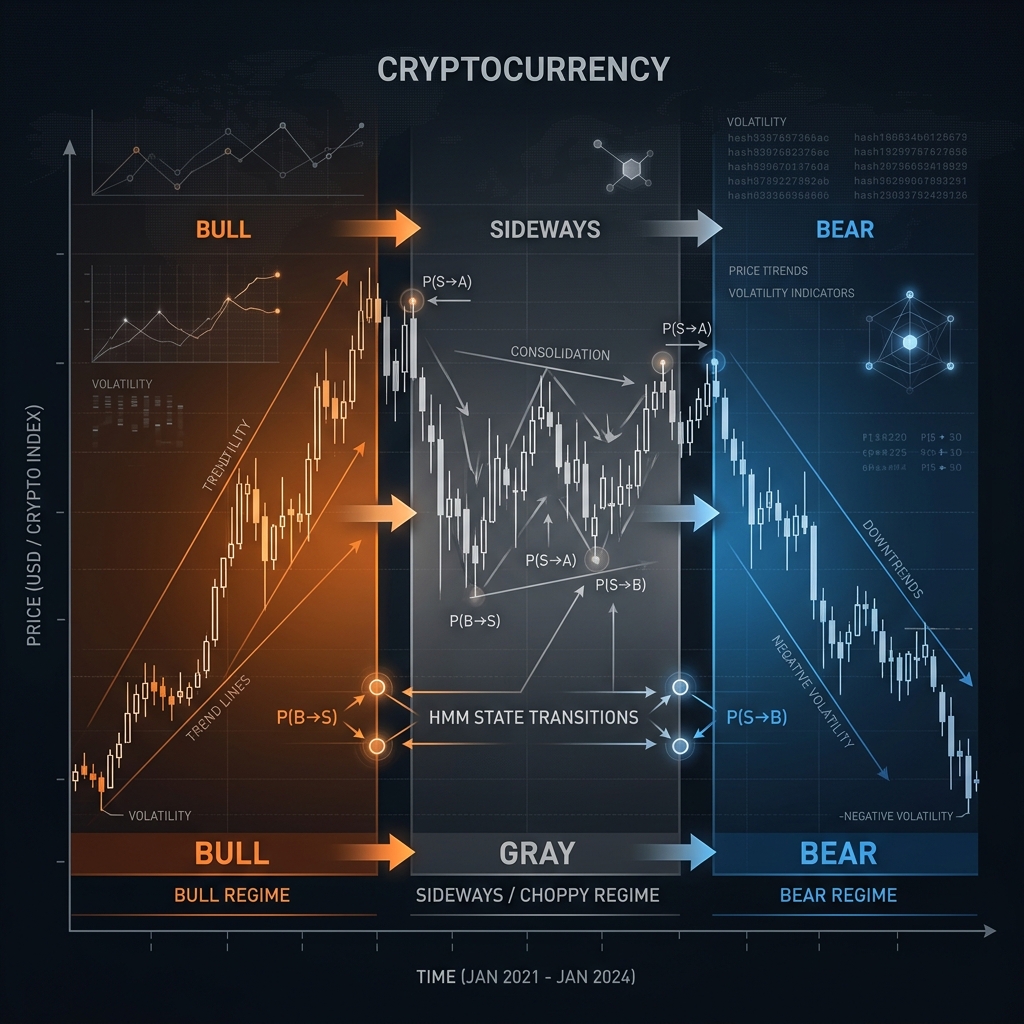
At StockHunt, we retrain the CoinIQ signal model on a rolling 90-day window, with a daily incremental update. This keeps the model anchored to current market microstructure while preserving the statistical depth of longer historical patterns. We also run regime detection as a meta-model that can switch the primary signal model between a bull, bear, and choppy-market variant depending on detected conditions.
What This Means for You as a Trader
If you're trading crypto without AI-augmented insight today, you are competing against participants who are. That doesn't mean you need to build your own model from scratch — it means you need access to a platform that has done that work for you.
CoinIQ, embedded into StockHunt's trading terminal, delivers real-time directional signals with confidence scores, entry timing recommendations, and automated risk parameters. In backtested performance across 2022–2025 market cycles, the model achieved a 87.4% historical win rate on directional calls with a minimum 2:1 reward-to-risk filter applied.
AI is not replacing human judgment — it is augmenting it. The best traders in 2025 are those who know how to ask the right questions of their AI tools and override them when qualitative judgment demands it.
The Road Ahead
We are still in the early innings of AI's impact on crypto trading. As on-chain data becomes richer, as cross-chain activity grows, and as institutional capital continues flowing into digital assets, the volume of signal-generating data will explode. The firms that build the infrastructure to process and act on that data fastest will own the next decade of market alpha.
For individual traders, the message is clear: embrace the tools, understand their limitations, and use them as a force multiplier for your own market intuition. The era of flying blind in crypto is over — and that is unambiguously a good thing.